Bonnie & Clyde

Bonnie & Clyde, 39 x 25.5 x5”, oil and wood stain on found wood pallet, 2026
Bonnie & Clyde begins with a 1940s photograph of my third great-grandparents, Avery Sampy and Claudia Babineaux, remembered by my grandfather as “having money”. Their carefully composed image becomes a point of departure for questioning what wealth, security, and success meant for a Black family in rural Louisiana. Through carved found wood, adornment, and references to the American flag, I consider the labor required to carve out a life within systems that restricted Black access to land, education, and economic mobility. The work looks beyond the photograph’s presentation of prosperity toward what it cannot reveal: the conditions surrounding that image and what could, or could not, be passed down. Bonnie & Clyde asks how Black families constructed images and lives of possibility, and what it takes for prosperity to become inheritance.
About
Avery & Claudia: The Family Photograph
Bonnie & Clyde begins with a family photograph of my third great-grandparents, Avery Sampy and Claudia Babineaux, taken in rural Louisiana during the 1940s. My grandfather remembered them as “having money,” and the photograph seems to support that memory. They are carefully dressed and composed, presenting themselves as a couple with a degree of prosperity, stability, and dignity. But the archive complicates what the image appears to promise. Avery and Claudia came from agricultural families and had little access to formal education. Avery eventually appears in the census as a farmer working “on his own account,” yet their son Harold would later become a tenant farmer, and their grandson Mabry would grow up sharecropping.
I am interested in this tension between the family photograph, family memory, and institutional record. Photography allowed Black families to construct and circulate images of themselves beyond the ways they were represented by the dominant culture. At the same time, every photograph contains an outside. The field remains outside the frame while shaping the lives inside it. So instead of approaching this image as proof of wealth or evidence of some type of deception, I see it as an act of self-fashioning. I am asking what they wanted this image to preserve, what it allowed them to say about themselves, & what remained beyond its borders.
Coordinates/ References
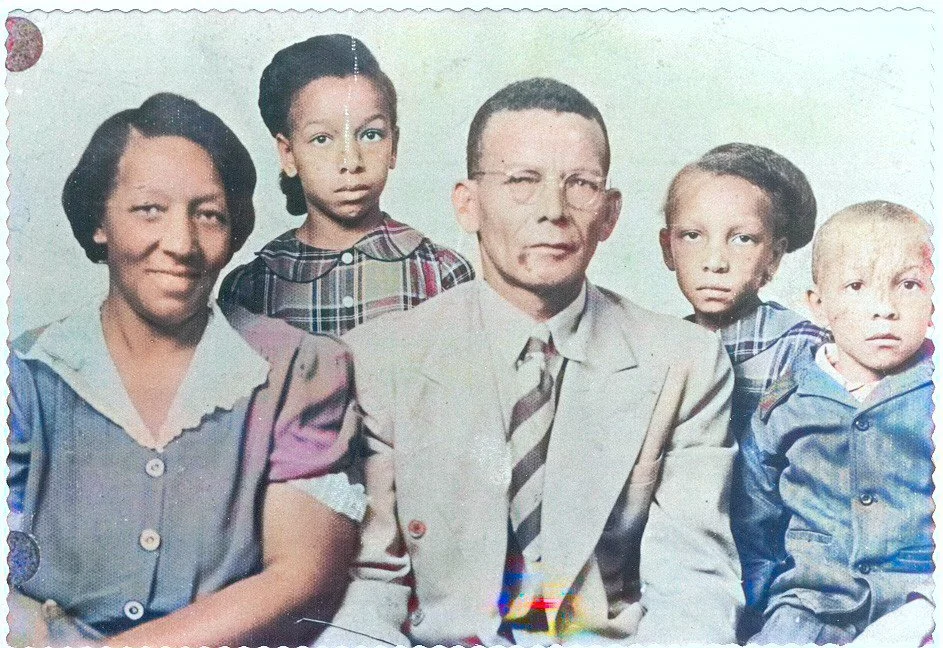
Artist’s third great grandpanrents & their children (1940s); Claudia Babineaux, Iris Sampy Monnet, Avery Sampy, Amy Sampy Livings, Emery Sampy
“For black folks, the camera provided a means to document a reality that could, if necessary, be packed, stored, moved from place to place. It was documentation that could be shared, passed around. And, ultimately, these images, the world they recorded, could be hidden, to be discovered at another time. Had the camera been there when slavery ended, it could have provided images that would have helped folks searching for lost kin and loved ones. It would have been a powerful tool of cultural recovery.”
-bell hooks, Art on my mind
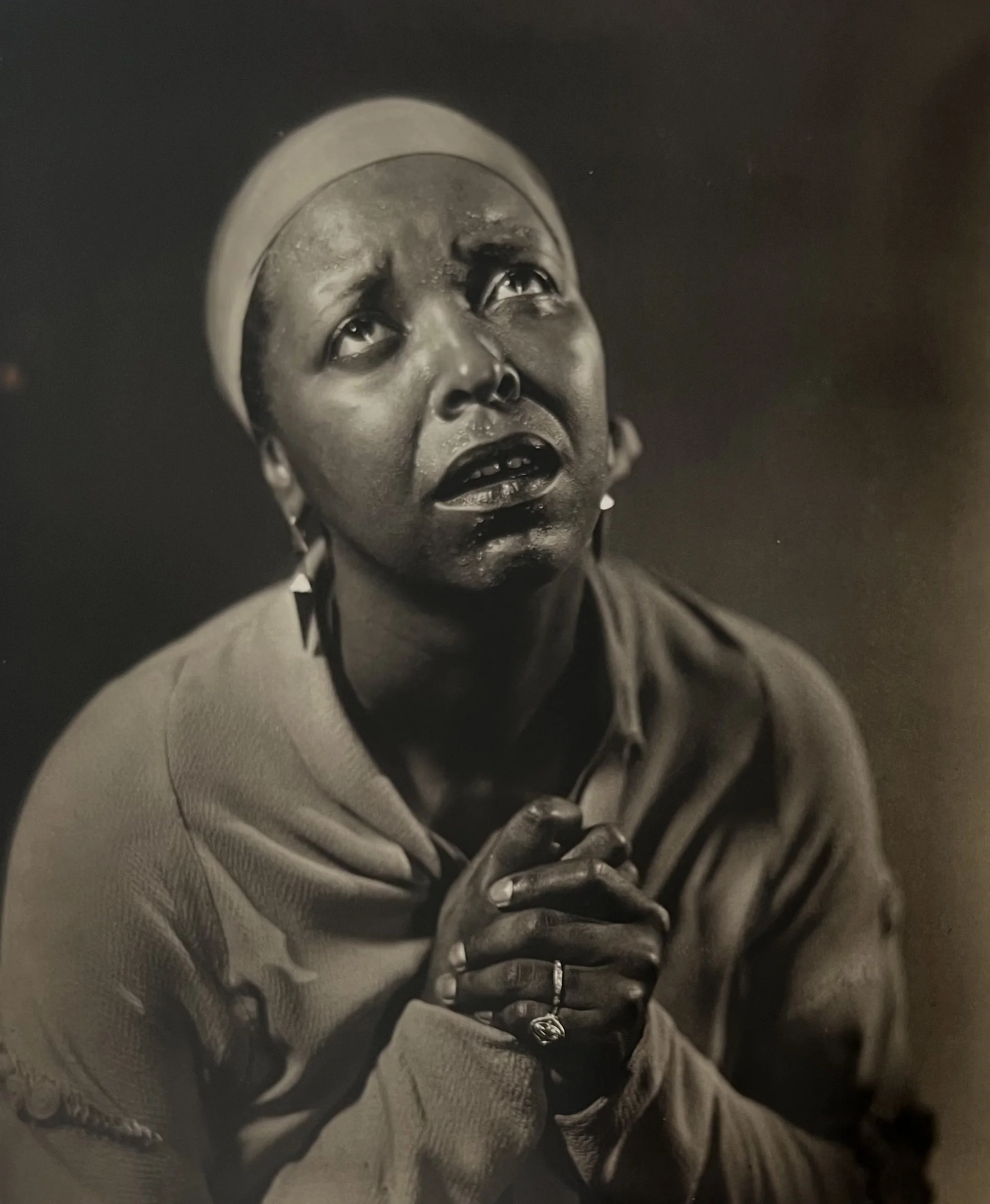
Ethel Waters photographed by Alfredo Valente
Bonnie & Clyde: Family as Strategy
The title Bonnie & Clyde positions the couple not simply as a romantic partnership, but as an economic, social, and protective alliance. Marie Jenkins Schwartz writes about enslaved families creating private lives within the slave quarters that allowed people to understand themselves as mothers, fathers, husbands, wives, siblings, and extended kin rather than solely through the identity imposed upon them as property. Families pooled labor and resources, protected children, supplemented inadequate provisions, and constructed forms of life beyond what enslavers provided.
Within the piece, man and woman also occupy recognizable gendered positions. She becomes the praying mother and visual representative of the household's condition. He becomes the provider, the figure expected to carve out material security for his family. Family is a site of love, faith, continuity, and futurity, but within agricultural economies it can also become a labor structure.
Carving Out the American Dream
Bonnie & Clyde is constructed on a found wood pallet, a material associated with holding, storing, and shipping goods. Carving into the wood makes physical the idea of carving out a life, extracting security from conditions that resist you.
Above the couple, a star-spangled banner is carved into the upper panels. I think about the American Dream as a promise that labor can be converted into prosperity, prosperity into security, and security into inheritance. My family's history and many others' histories complicate that progression. The repetition of agricultural labor across generations makes me question what hard work was actually able to secure. My family did not lack labor. What appears less certain is whether that labor could become something durable enough to alter the starting position of the next generation.
Saidiya Hartman’s writing on the failures and unfinished condition of emancipation have helped me understand these contradictions. Freedom promised self-possession and individual possibility while Black people continued to encounter economic structures that constrained what could be accumulated, owned, and transferred. I am interested in carving because it requires pressure against resistant material. Something must be removed for something else to appear. The marks of that struggle remain visible.
The banner above places this family underneath a national proposition: work hard enough and you can make something for yourself. I started this piece asking “Where did the wealth go?”, and it eventually became: What does it mean to “make it” when the next generation may still have to carve out its own security?